South Korea overhauls grid rules to connect more than 100 gigawatts of renewables by 2030
Flexible connections, battery storage and competitive allocation of grid rights will replace hard limits that left projects waiting in congested regions.
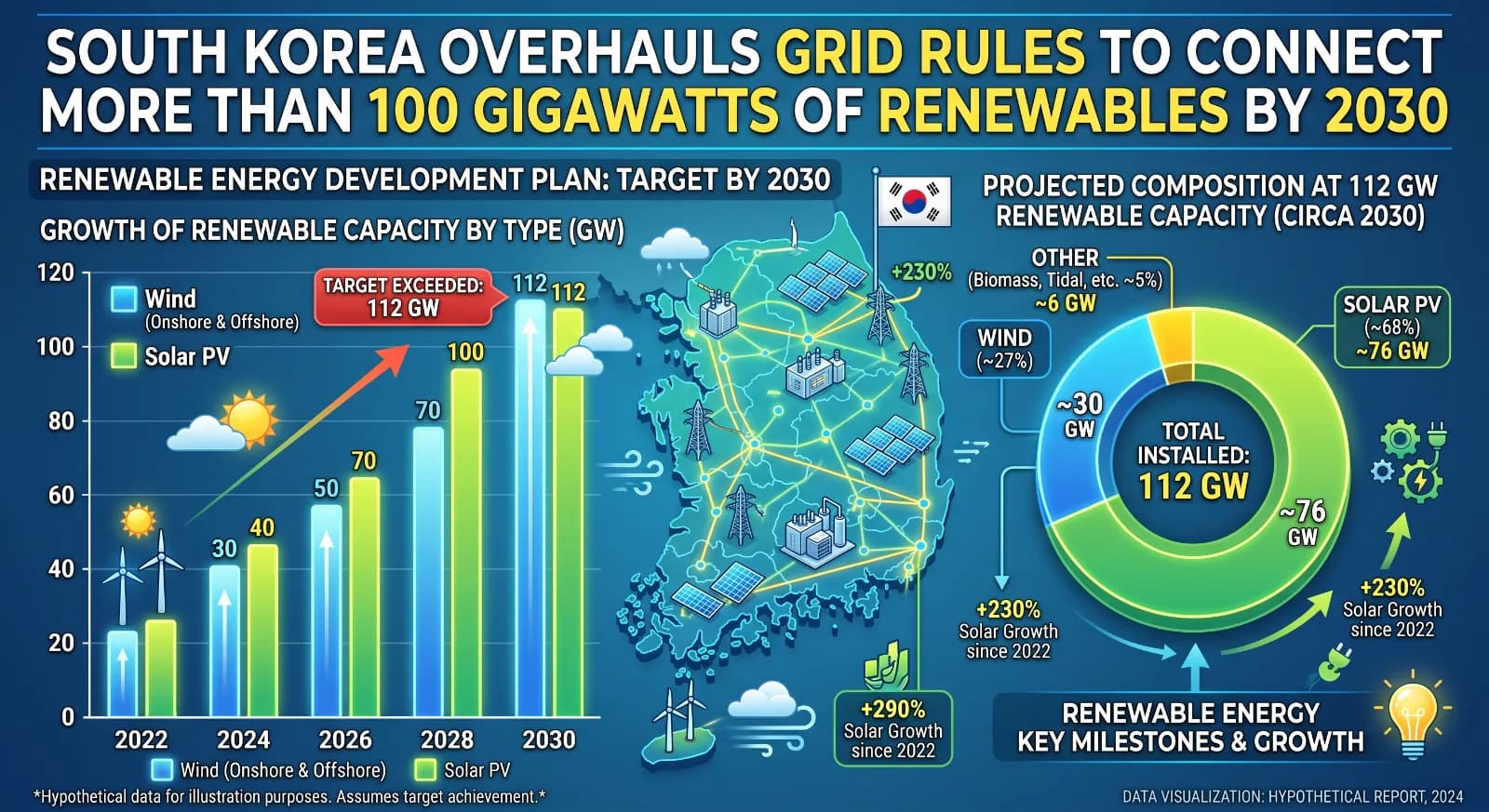
South Korea will let renewable projects connect beyond a grid's normal limit in exchange for accepting curtailment, part of an overhaul aimed at accommodating more than 100 gigawatts of renewable capacity by 2030.
The Ministry of Climate, Energy and Environment lifted restrictions on new renewable connections in the southwestern Honam region, Brian Publicover reported Oct. 1 in pv magazine. Projects already in the queue get priority, while new projects will apply under a revised framework from January 2027.
Under the flexible-connection rules, solar limits rise from 14 to 16 megawatts on a distribution line and from 50 to 60 megawatts at a substation, which the ministry estimates will add 2.6 gigawatts of solar in Honam without new lines. It also plans to connect 4.6 gigawatts of solar in congested areas through battery storage by 2030.
The ministry has reclaimed 9 gigawatts of connection rights held by unviable projects and will now assume in grid studies that renewables are dispatched ahead of fossil fuel plants, a change it estimates frees room for 20 gigawatts nationwide. From January 2027, connection rights will go to projects chosen through competitive bidding rather than on a first-come, first-served basis.
The measures are projected to lift national transmission-level renewable hosting capacity from 119 gigawatts to 171 gigawatts by 2030. Separately, the Korea Power Exchange opened a tender Sept. 22 for 1,100 megawatts of six-hour battery storage under 15-year contracts.
This brief is based on reporting by Brian Publicover, published Oct. 1, 2026, in pv magazine. Read the original: https://www.pv-magazine.com/2026/10/01/south-korea-grid-overhaul-to-connect-more-than-100-gw-of-renewables/
This article was produced with the assistance of AI tools and reviewed by an editor before publication.