Climate crisis: How a clacier unleashed an apocalyptic flood in Nepal
What was initially recorded as a 5.2-magnitude earthquake on Wednesday morning was actually the sound of the Himalayas breaking apart.
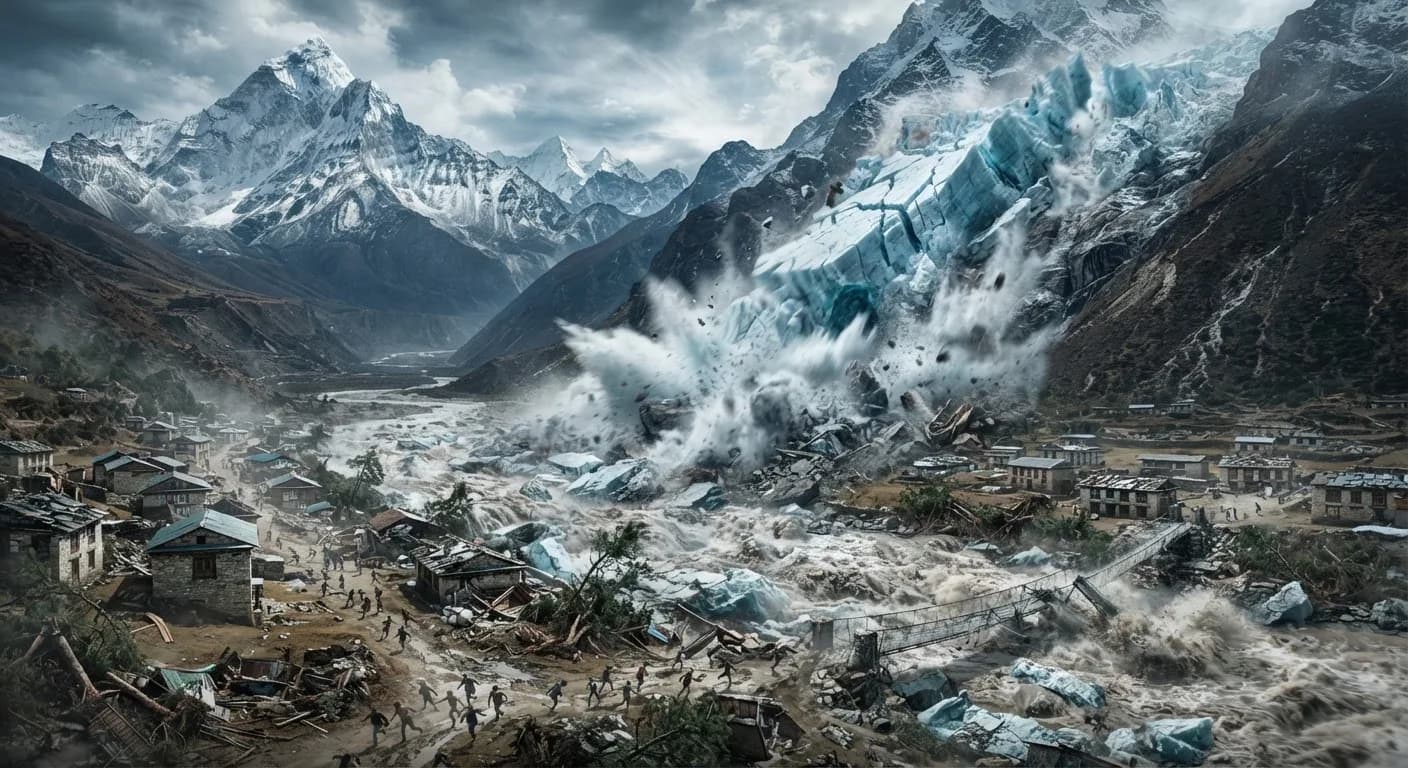
At 8:37 a.m. local time, an enormous section of a glacier—roughly 2,000 feet wide—snapped off its mountainside in Nepal's Langtang National Park near the Tibetan border. The colossal block of ice plummeted 4,000 vertical feet to the valley floor below. The impact was so violent that the ice pulverized instantly, unleashing a devastating flash flood of water, rocks, and mud that has killed over 600 people across Nepal and China, leaving thousands more missing.
While often described by onlookers and in passing as a falling "iceberg," this event was technically an ice avalanche. Icebergs are free-floating chunks of ice in oceans or lakes; Wednesday’s disaster involved a sheer face of ancient, high-altitude glacial ice breaking away from a 17,000-foot mountain peak.
Glaciers in Langtang National Park cling to incredibly steep, jagged rock faces. When a chunk of ice roughly the area of 25 professional soccer fields shears off from that height, it carries immense potential energy.
"It looks like a glacier in the area basically snapped off in a clean break," said Daniel Shugar, a geomorphologist at the University of Calgary who analyzed satellite imagery of the disaster. "The bottom looks like a bomb exploded—it's just deposits from the broken-up glacier."
With the narrow Himalayan topography acting as a funnel, the pulverized ice transformed into a raging slurry that surged down the Lhende Khola valley, eventually plunging into the Bhotekoshi and Trishuli river systems.
The wall of water and debris obliterated everything in its path. Terrifying CCTV footage from the Gyirong border post showed a tsunami of mud swallowing a multi-story building and lines of buses as people ran for their lives. Further downstream in Nepal, highways, bridges, and hydropower infrastructure were washed away in seconds.
For the communities living along the riverbanks, the disaster unfolded with apocalyptic speed. Keshav Prasad Baral, a 68-year-old survivor, watched a huge gush of mud enter his home. "I tried to grab my wife's hand and take her to the terrace, but she was swept away by the mud," he recalled from a hospital bed. "My wife is still somewhere beneath the mud. She's gone."
Another survivor, Bibek Kumal, escaped death only by clinging to a mango tree as the torrent gouged through his riverside town.
Glaciologists and climate scientists view the collapse as a grim harbinger. The Himalayas are currently warming twice as fast as the global average, causing the region's glaciers to shrink at an unprecedented rate. Satellite imagery from the days prior showed that warm temperatures had stripped the valley's glaciers of their protective snow cover, leaving bare ice exposed. Experts believe this rapid melting likely allowed water to pool beneath the ice, creating a lubricating layer that caused the glacier to slide off the mountain.
As rescue teams continue to wade through knee-deep sludge to find the missing, a newly formed lake upstream now threatens to overflow, halting recovery efforts. For the thousands of residents in the shadow of the Himalayas, Wednesday’s catastrophe is a stark reminder of how quickly a rapidly warming climate can turn remote mountain peaks into a deadly wall of water.