Ocean heat waves and acidity spikes strike together more often than chance would predict
Researchers used four decades of satellite and ship data to map 500 compound events, including overlooked ones in the open ocean.
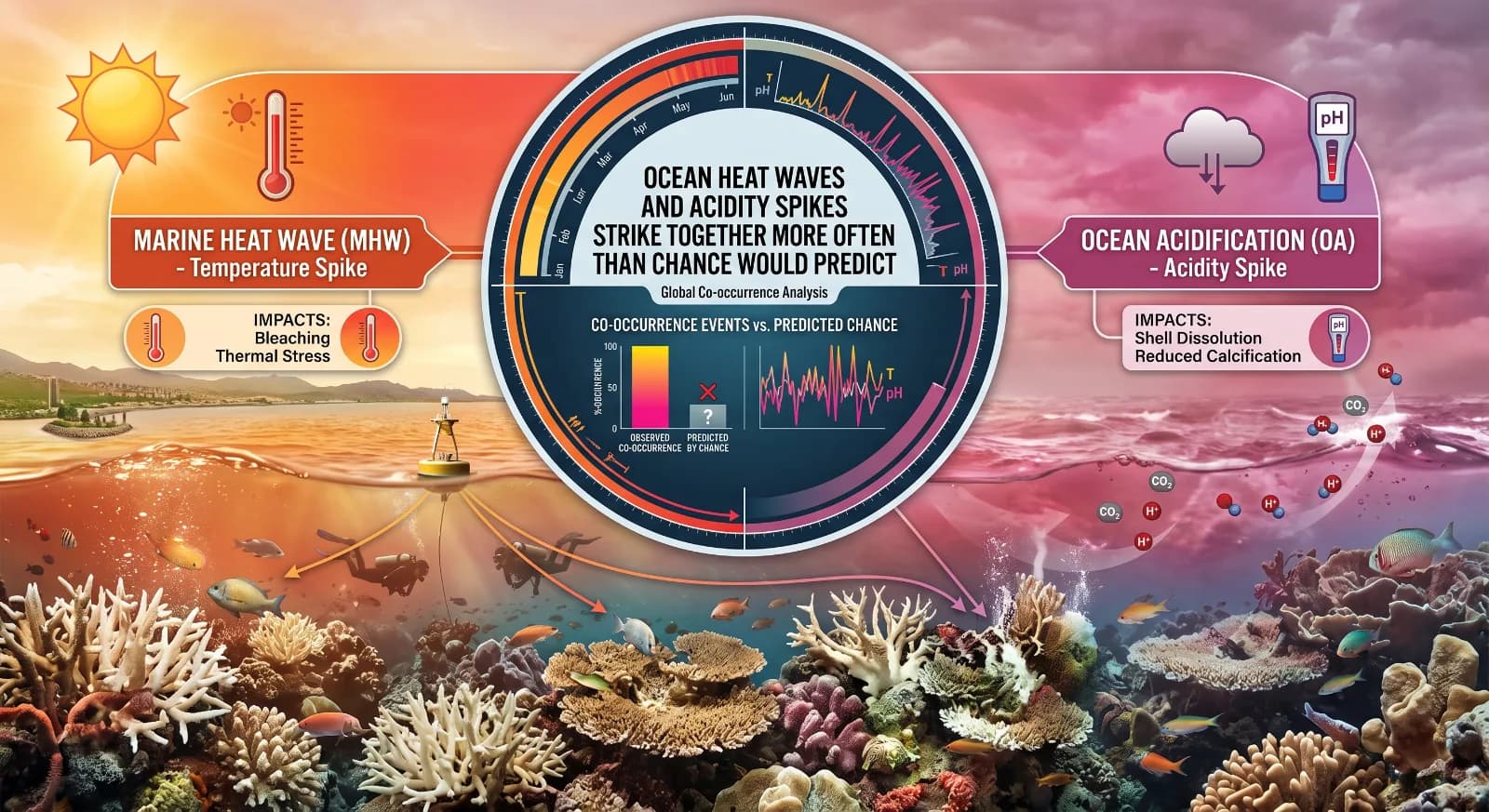
Marine heat waves and spikes in ocean acidity hit the same waters at the same time more often than chance alone would explain, according to a study that maps four decades of these compound extremes worldwide.
Researchers at the Swiss Federal Institute of Technology in Zurich (ETH Zurich) combined ship-based measurements of dissolved carbon dioxide with satellite data on temperature, salinity and chlorophyll, and used machine learning to fill the gaps, producing 504 monthly global acidity maps from 1982 to 2024. Overlaying them with heat wave records, they identified 500 compound events. The study was published in August in AGU Advances, a journal of the American Geophysical Union.
Most events were small and brief: 67% lasted less than three months and averaged about 500,000 square kilometers. A few persisted for up to 20 months. The data also surfaced overlooked episodes, including a 2016 event in the southwest Pacific that covered 4 million square kilometers. Such open-ocean events often go unnoticed, but "that doesn't mean that marine life isn't affected," said Luke Gregor, one of the study's authors.
The findings come as a strong El Niño develops. The team found compound extremes are four times more likely where ocean layers don't mix and are tied to phases of the El Niño and La Niña cycle; near the equatorial Pacific, the risk rises toward the end of an El Niño.
Antonietta Capotondi, a physical oceanographer at the University of Colorado who was not involved in the research, said understanding these extremes could be a first step toward limiting harm to fisheries.
This brief is based on reporting by Autumn Spanne, published Sept. 29, 2026, in Mongabay. Read the original: https://news.mongabay.com/2026/09/new-global-maps-chart-40-years-of-ocean-heat-and-acidification-extremes/
This article was produced with the assistance of AI tools and reviewed by an editor before publication.