AI data centers drive 76% jump in US gas plant construction
Global Energy Monitor's July 2026 data shows artificial intelligence data centers have built up a 378 GW gas plant pipeline in the United States. Türkiye, with a target of 1 GW of data center capacity by 2030, is assembling a smaller-scale version of the same trade-off.
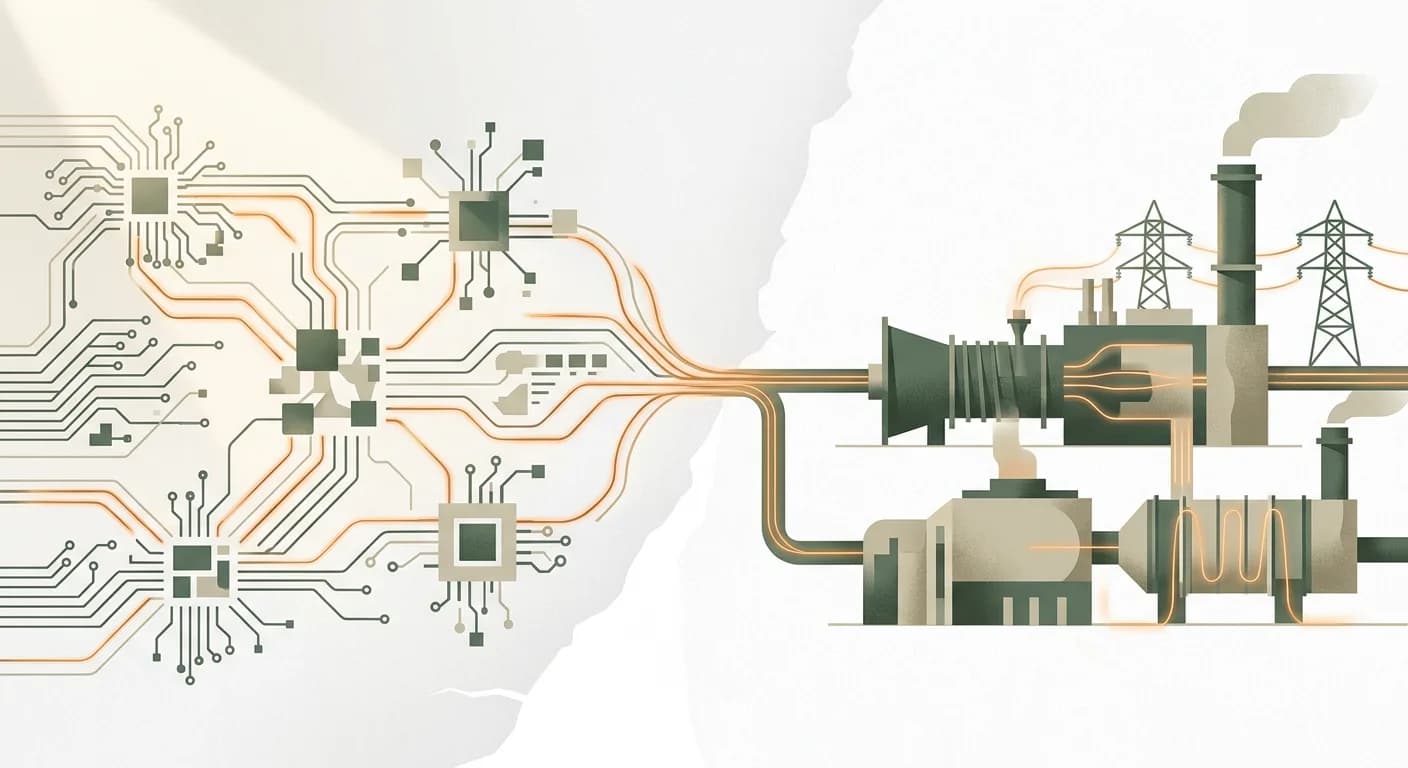
Natural gas power plant capacity actually under construction in the United States rose 76 percent in the first half of 2026, reaching 52 GW. According to an analysis published on 25 August by Global Energy Monitor (GEM), based on the July 2026 update of its Global Oil and Gas Plant Tracker, that figure is roughly double the 24 GW under construction in China. As recently as six months ago, China was the leader in capacity under construction.
The main driver of the increase is identified as the acceleration in construction of artificial intelligence data centers. By GEM's count, 16.9 GW of the 52 GW under construction consists of projects planned specifically to supply data centers.
The picture at the planning stage is even larger. Since the organization's January 2026 data release, gas capacity in development in the United States has risen 50 percent (+127 GW), from 252 GW to 378 GW — roughly one third of the global total. GEM counts 189 GW of that pipeline — the sum of the announced, pre-construction and construction stages — as planned to meet electricity demand driven by data centers. If all the projects go ahead, the existing US gas fleet would grow by about two thirds; the organization estimates the investment cost at more than 647 billion dollars. Texas alone accounts for roughly one third of the pipeline (around 122 GW).
GEM is the only source for these figures; there is no equivalent set of numbers produced separately by an independent institution.
A large pipeline, uncertain delivery
Some 86 percent of the project pipeline is still at the announced or pre-construction stage. In other words, there is a high likelihood that a significant share of the 378 GW will never turn into concrete. In GEM's own assessment, the main obstacle to growth is identified as the bottleneck in gas turbine supply: order backlogs and delivery times at the three major turbine manufacturers are lengthening, and two thirds of the projects in development have yet to name a turbine supplier.
There are also signs of a pullback on the demand side. The US Energy Information Administration's August 2026 Short-Term Energy Outlook notes that the state's electricity demand forecast was revised downward after the governor of Texas announced on 3 August a pause on new data center development: the expected load growth for 2027 was cut from 14 percent to 6 percent. The same agency also modeled a scenario in which fossil-fueled generation could increase if data center demand grows faster than expected.
In the short term, capacity added to the grid is still predominantly renewable. According to Energy Information Administration data, of the 86 GW of capacity scheduled to come online in the United States in 2026, 43.4 GW is solar, 24.3 GW is battery storage and 11.8 GW is wind; new capacity planned for natural gas is 6.3 GW. This figure cannot be compared directly with GEM's project pipeline, because one measures capacity to be connected this year and the other a stock of plans spread over several years.
The same calculation faces Türkiye
According to the International Energy Agency's Electricity 2026 report, roughly half of the expected growth in US electricity demand through 2030 will come from data centers. In Türkiye the scale is much smaller, but the direction is similar.
Türkiye's Artificial Intelligence Action Plan for 2026-2030, which entered into force with Presidential Circular No. 2026/9 published in the Official Gazette on 18 August 2026, envisages raising installed data center capacity to at least 1 GW by 2030. The Ministry of Industry and Technology announced a target of mobilizing 10 billion dollars in data center and artificial intelligence investment by 2030; support mechanisms are being offered for data centers with a minimum capacity of 30 MW. According to Anadolu Agency, the total size of the hyperscale data center project to be built in Ankara through a partnership between Turkcell and Google Cloud is 3 billion dollars, and the facility is expected to come online at full capacity in 2028.
It is not yet clear which sources will cover this load. According to Ministry of Energy and Natural Resources data, Türkiye's installed electricity capacity reached 126,476 MW at the end of July 2026; renewables account for 62.8 percent, with solar and wind together making up 33.8 percent. In the same data set, about 25,000 MW of installed capacity consists of natural gas plants, and 23 percent of the 363 billion kWh of electricity generated in 2025 (83 billion kWh) came from gas. Almost all of that gas is imported.
Two questions follow. The first is the source mix for the 1 GW data center load: there is no official breakdown of the mix from which planned facilities in Türkiye will draw their electricity. The second is cost: with the construction wave in the United States already tightening global turbine supply, the delivery time and price of new gas capacity to be built in Türkiye are not independent of that squeeze. If rising US gas demand creates price pressure in the LNG market, the effect will also reach Türkiye through the cost of electricity based on imported gas.
This article was produced with the assistance of AI tools and reviewed by an editor before publication.