China starts up 700-megawatt salt-cavern compressed air storage plant
The Jintan facility stores air in caverns 1,000 meters underground and can generate for four hours at full output without burning natural gas.
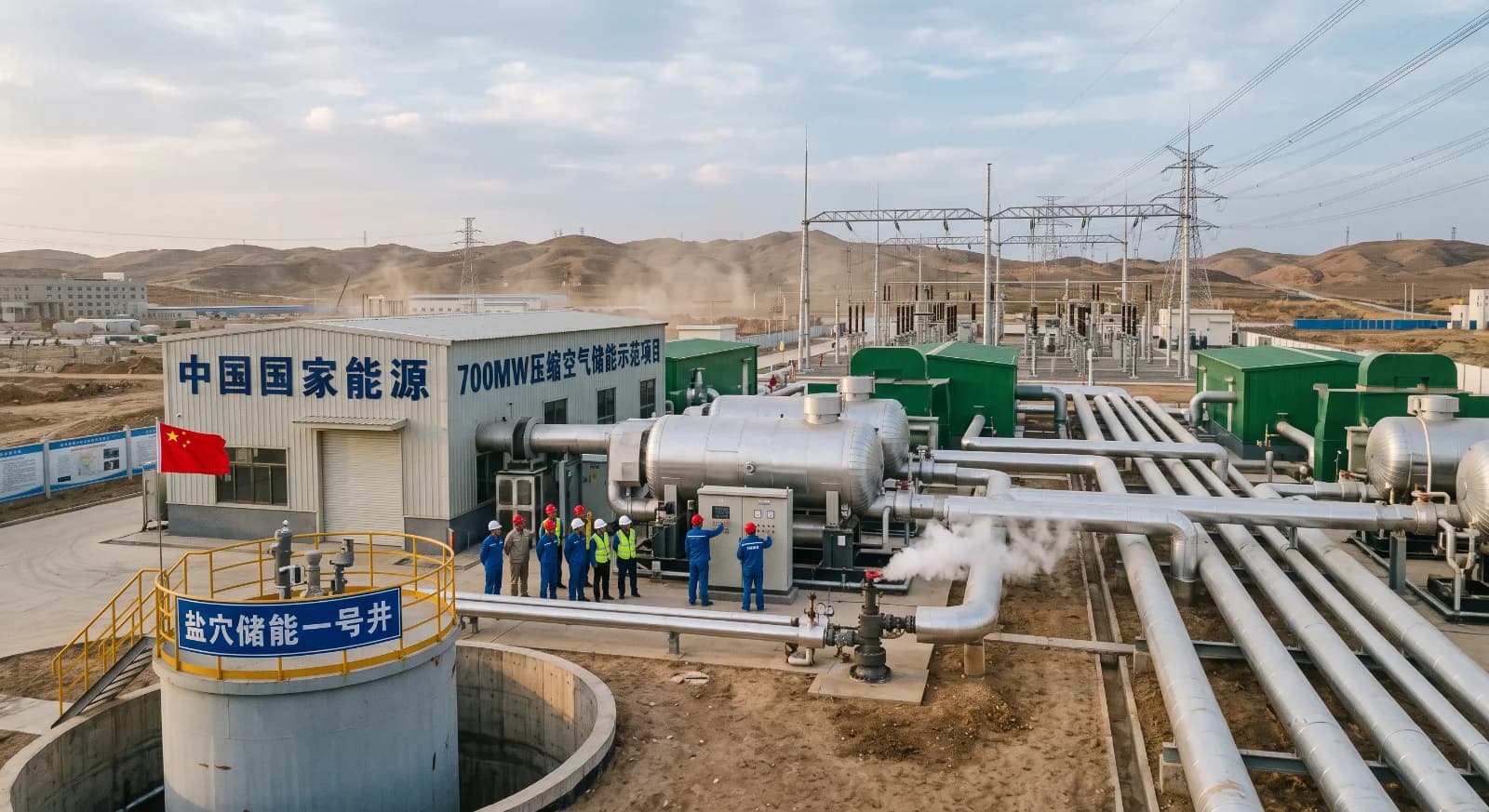
China Huaneng has completed full-system startup of a 700-megawatt compressed air energy storage (CAES) plant in eastern China's Jiangsu province, the largest salt-cavern facility of its kind reported anywhere in the world.
Both 350-megawatt units at the second phase of the Jintan project in Changzhou completed integrated startup testing Sept. 12, PV Magazine reported Monday. The plant now moves on to pre-grid-connection tests and commissioning.
The plant uses electricity to compress air to more than 130 atmospheres and pump it into four salt caverns about 1,000 meters underground, with a combined volume of about 1.2 million cubic meters. Heat from compression is captured in pressurized water at about 180 degrees Celsius in 16 spherical tanks, then used to reheat the air as it drives the turbines, so no natural gas is burned.
A full charge stores about 2.8 gigawatt-hours. The plant takes eight hours to charge, generates for four hours at rated output and recovers more than 70% of the energy it stores. It is expected to complete about 330 cycles a year, producing roughly 924 gigawatt-hours annually. The project's first phase, commissioned in 2022, was 60 megawatts.
China Huaneng developed the project with China Salt Group, with technical support from Tsinghua University. Together with the 300-megawatt Feicheng plant in Shandong province, Jintan shows China moving from demonstration projects to long-duration storage plants of several hundred megawatts that help integrate renewable power and balance the grid.
This brief is based on reporting by Vincent Shaw, published Oct. 5, 2026, in PV Magazine. Read the original: https://www.pv-magazine.com/2026/10/05/chinas-700-mw-jintan-salt-cavern-caes-project-completes-full-system-startup/
This article was produced with the assistance of AI tools and reviewed by an editor before publication.