Who Pays to Power the Data Center? Microsoft and Qcells Test a "Bring-Your-Own-Capacity" Model
Microsoft is partnering with solar panel manufacturer Qcells to power its data centers by renewable energy.
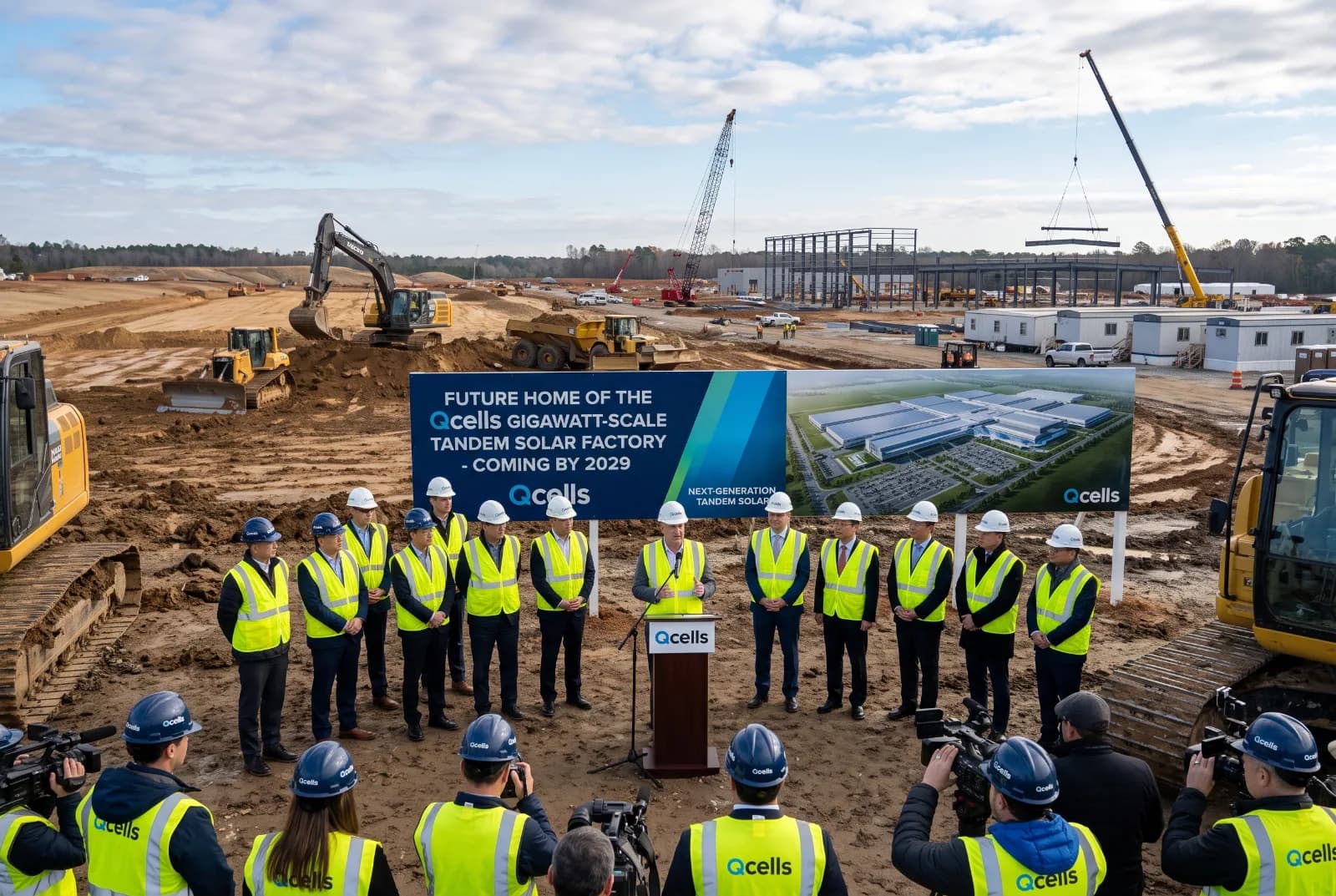
Solar panel manufacturer Qcells announced on August 19, 2026, that it is expanding its relationship with Microsoft, which has been ongoing since 2023, to pair artificial wireless network infrastructure with new energy capacity. The model is called "Bring Your Own Capacity" (BYOC) – roughly speaking, "bring your own capacity."
According to Qcells' model, the company will develop and build its own new energy infrastructure; the generated electricity can be supplied directly to Microsoft or to local power sources serving the data center's area. Microsoft, in turn, will undertake the production capacity required for its own operations.
The announcement states that the second leg of the collaboration involves virtual power plants that combine residential and commercial batteries into a single flexible source. Qcells says this will brighten the outlook for low-income households, and coordination will be provided through Microsoft Fabric and Azure.
However, what the announcement doesn't say is just as important. The text doesn't specify the capacity amount (MW or GW), the investment segment, the states where it will be implemented, or the timeline. It uses a three-dimensional "research" language. The virtual power plant device doesn't specify how many batteries will be assembled, in which markets, or with which payment model. The commitment to "increasing the visibility of low-income households" also lacks a measurable target. The primary text regarding the announcement is Qcells' own statement; a separate official publication from Microsoft on the subject has not yet been identified.
From suppliers to energy developers
The relationship between the two companies began in 2023 with the announcement of 2.5 GW of enhanced solar modules and EPC services in the US, and was expanded in January 2024 with an eight-year, 12 GW joint installation. According to Qcells' periodic statements, the company planned to supply modules from its integrated factory in Cartersville, Georgia, built with a $2.5 billion investment. This latest step can be interpreted as an attempt to move from a large module vendor to an energy developer.
The background is Microsoft's own carbon footprint. According to its 2026 Environmental Sustainability Report, published on July 9, 2026, Scope 1, 2, and 3 emissions in fiscal year 2025 increased by 25 percent year-on-year, rising from 16 million tons to 20 million tons of CO2. Microsoft attributed the increase to systemic reasons such as data center expansion and the cessation of "non-additional" energy certificate purchases. The company's goal of becoming carbon negative by 2030 remains unchanged.
From voluntary commitment to commercial model
In the US, the debate over continuing to pass on data center demand to household electricity bills was brought to the policy level in 2026. Microsoft is one of seven signatories to the Ratepayer Protection Pledge, signed at the White House on March 4, 2026. This commitment includes a promise to build or purchase new production capacity for data center demand and not pass on grid investment costs to households.
According to POWER Magazine, the commitment was expanded on July 23, 2026, to include blocks of electricity companies, cooperatives, data center developers, and validators. This commitment is described as a voluntary, non-binding text. Microsoft also defined the first commitment of its Community-First AI Infrastructure initiative, announced on January 13, 2026, as data centers increasing regional electricity prices.
In short, the Qcells announcement is an attempt to translate a voluntary promise into the language of a commercial contract. Whether the installed capacity will be a "net addition" to the grid cannot be independently verified. This carries the risk of a new iteration of the "non-additional certificate" solution model that Microsoft itself acknowledged in its report.
This article was produced with the assistance of AI tools and reviewed by an editor before publication.