Florida removes climate change content from schoolbooks as publishers oblige
Records obtained under Florida's public records law show that in textbooks awaiting state approval, the phrase "climate change" gave way to vague formulations such as "changes in the environment."
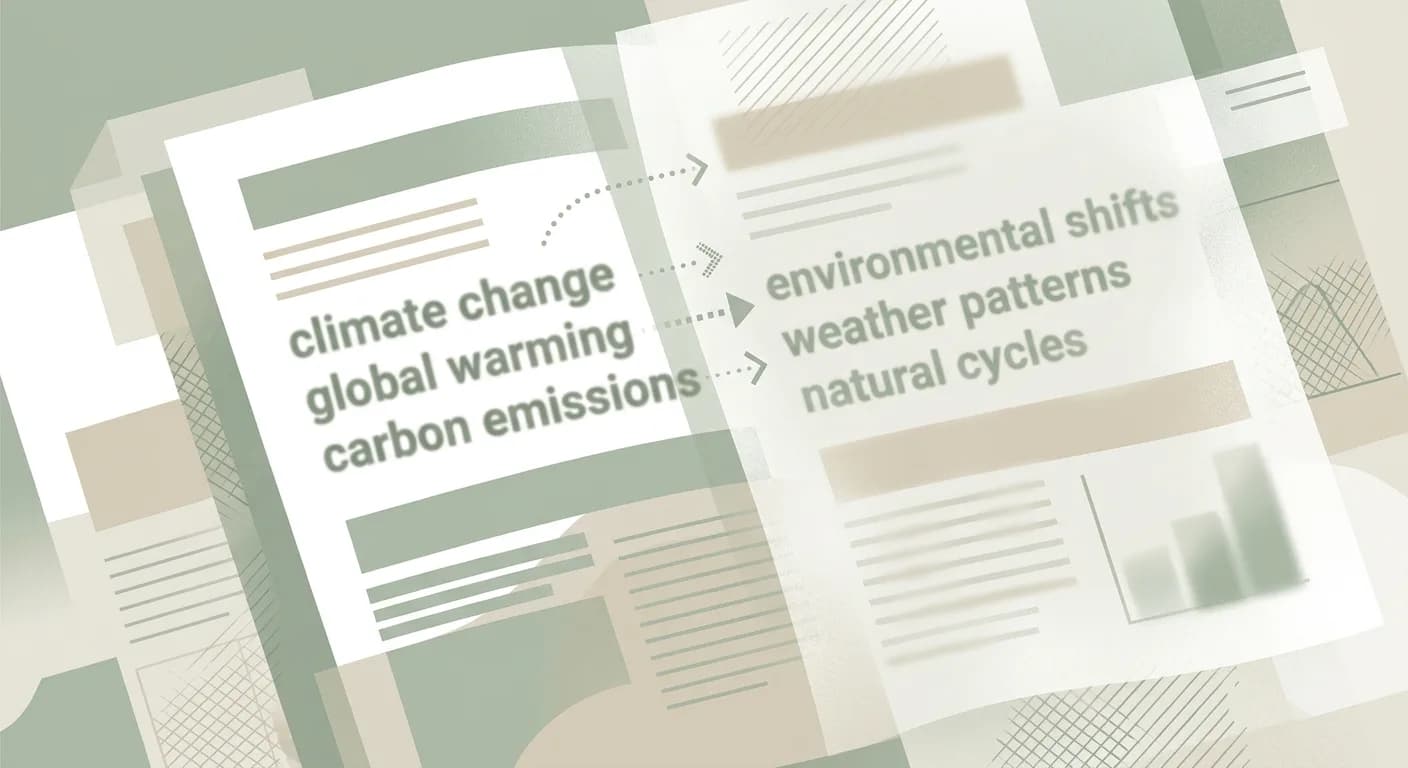
In the US state of Florida, science textbook publishers have watered down or entirely removed sections on climate change to gain statewide approval for their books. The request came from the Florida Department of Education, and publishers largely complied.
The information is based on a joint investigation published on August 20, 2026, by the public broadcaster WUSF and The Hechinger Report, a nonprofit newsroom focused on education reporting. Journalists from both organizations requested correspondence between the department and publishers under Florida’s public records law; the documents were obtained after a wait of more than a year. The correspondence covers exchanges made in the summer of 2024 when books awaiting statewide approval were being evaluated.
Deleted sentences
According to the investigation, the phrase "climate change" was replaced with "changes in the environment" in one instance in a McGraw Hill marine science textbook. In a Cengage environmental science textbook, the word "polluting" was removed from before "coal-burning power plants," and a section detailing how University of Washington students voted to pay an extra fee to purchase renewable electricity was cut. WUSF and The Hechinger Report separately reported these two examples.
In another example reported by The Hechinger Report, which lacks independent verification, the first draft of a marine science textbook stated that climate change causes at least 150,000 deaths a year and that an additional 1-degree Celsius of warming would double this number. In the final version of the book, this section was replaced by a general statement making no reference to climate change. The original scientific source for this estimate is unclear from the correspondence.
The distribution of the changes does not appear random either. According to WUSF and Hechinger’s review of the approval data, the courses most likely to contain climate content—environmental science, earth science, and marine science—were directly approved at less than half the rate of other science course textbooks. The state approved most of the books only after the publishers made changes.
"Not necessary for alignment with standards"
Glenn Branch, Deputy Director of the National Center for Science Education (NCSE), says the changes were not necessary to align the books with state science standards and described the request to dilute climate change coverage as "highly unusual." The NCSE had previously reported in its own monitoring efforts that the department requested the removal of climate references from books evaluated for approval in 2024.
Publisher representatives argued that the changes made were consistent with the scientific integrity of the climate discussion. However, the author of the marine science textbook stated that the changes did not represent a scientific or pedagogical improvement. The Florida Department of Education’s rationale remains unknown, as the agency did not respond to journalists' questions.
The correspondence coincides with a broader policy trend in the state. According to a compilation by the Sabin Center for Climate Change Law, Governor Ron DeSantis signed bill HB 1645 into law on May 15, 2024. The law removed most references to "climate change" from state legislation, banned offshore wind turbines in state waters, and ended certain grants and mandates related to renewable energy and energy efficiency.
Florida's science education standards have not been updated since 2008 and are the oldest in the country. The revision process began in November 2024, a few months after the correspondence with publishers; the standards will be submitted to the State Board of Education for approval. According to the NCSE’s assessment, the current 2008 standards require examining the conditions that contribute to global climate change at the high school level but do not address the human-caused aspect; there is no climate change standard for elementary and middle schools. In the "Making the Grade?" report published by the NCSE and the Texas Freedom Network Education Fund in 2020, Florida's standards received a D grade for climate content. The report noted that out of 50 states and Washington D.C., only 27 scored a B+ or higher, and six states received an F.
Different mechanism in Türkiye, same question
In Türkiye, curricula and textbooks are prepared centrally by the Ministry of National Education; there is no state-publisher approval negotiation like in Florida. The Ministry's 8th-grade science curriculum under the "Century of Turkey Education Model" (Türkiye Yüzyılı Maarif Modeli) includes a "Seasons and Climate" unit, defining learning outcomes related to climate and weather events. The Ministry also prepared an activity guide aimed at the environmental and climate literacy of middle school students under the "Environment, Disaster, Risk Reduction, and Education Project (ÇARE)," conducted in line with the Climate Change Action Plan.
On the other hand, there is no independent assessment regarding at which grade level and to what depth the human-induced nature of climate change, the role of fossil fuels, and mitigation policies are covered in the Turkish curriculum. A 2021 UNESCO study examining the national curriculum frameworks of 100 countries noted that only 53% of curricula make any reference to climate change, and 40% contain very limited content. In another UNESCO review scanning over 530 9th-grade science and social sciences curricula from 85 countries, 69% of the curricula had no mention of climate change, and 66% had no mention of sustainability. A Turkey-specific score could not be identified in these scans.
What the Florida example shows is that removing climate information from the curriculum does not necessarily require an explicit ban: a publisher voluntarily diluting its own text during an approval process tied to public procurement yields the same result. In centralized curriculum models, this pressure becomes visible not in approval correspondence, but in which learning outcomes are assigned to which grades—and measuring this requires directly counting the learning outcomes.
This article was produced with the assistance of AI tools and reviewed by an editor before publication.